
By Global Web Sols SRL
Table of Contents
- Introduction: Why Digital Growth Requires a System
- Start With Clear Business Goals
- Build a High-Converting Website
- Use SEO to Attract the Right Audience
- Create Content That Builds Trust
- Use Paid Advertising to Generate Targeted Traffic
- Turn Visitors Into Leads With CRO
- Build a Strong Lead Generation Process
- Use CRM to Manage and Nurture Leads
- Automate Repetitive Marketing Tasks
- Use Social Media to Expand Your Reach
- Measure Performance With Analytics
- Combine SEO, Ads, Content and CRO Into One Growth System
- Digital Growth for eCommerce Businesses
- Using AI and Automation for Business Growth
- How to Build Your Digital Growth Strategy Step by Step
- Common Digital Growth Mistakes to Avoid
- How Global Web Sols Approaches Digital Growth
- Conclusion: Build. Market. Convert. Scale.
In today’s digital economy, having a website is no longer enough. Running occasional advertising campaigns is not enough either. Publishing on social media, sending emails, or investing in SEO as isolated activities may generate results, but businesses often struggle to understand how these activities work together.
A successful digital presence requires a connected strategy.
A business needs to attract the right audience, communicate its value clearly, convert visitors into leads or customers, manage those leads efficiently, and continuously improve its performance using reliable data.
This is where a digital growth strategy becomes important.
A digital growth strategy connects technology, marketing, user experience, conversion optimization, analytics, automation, and customer acquisition into one system. Instead of treating every marketing channel separately, businesses can create a process where each component supports the others.
At Global Web Sols, we describe this approach simply:
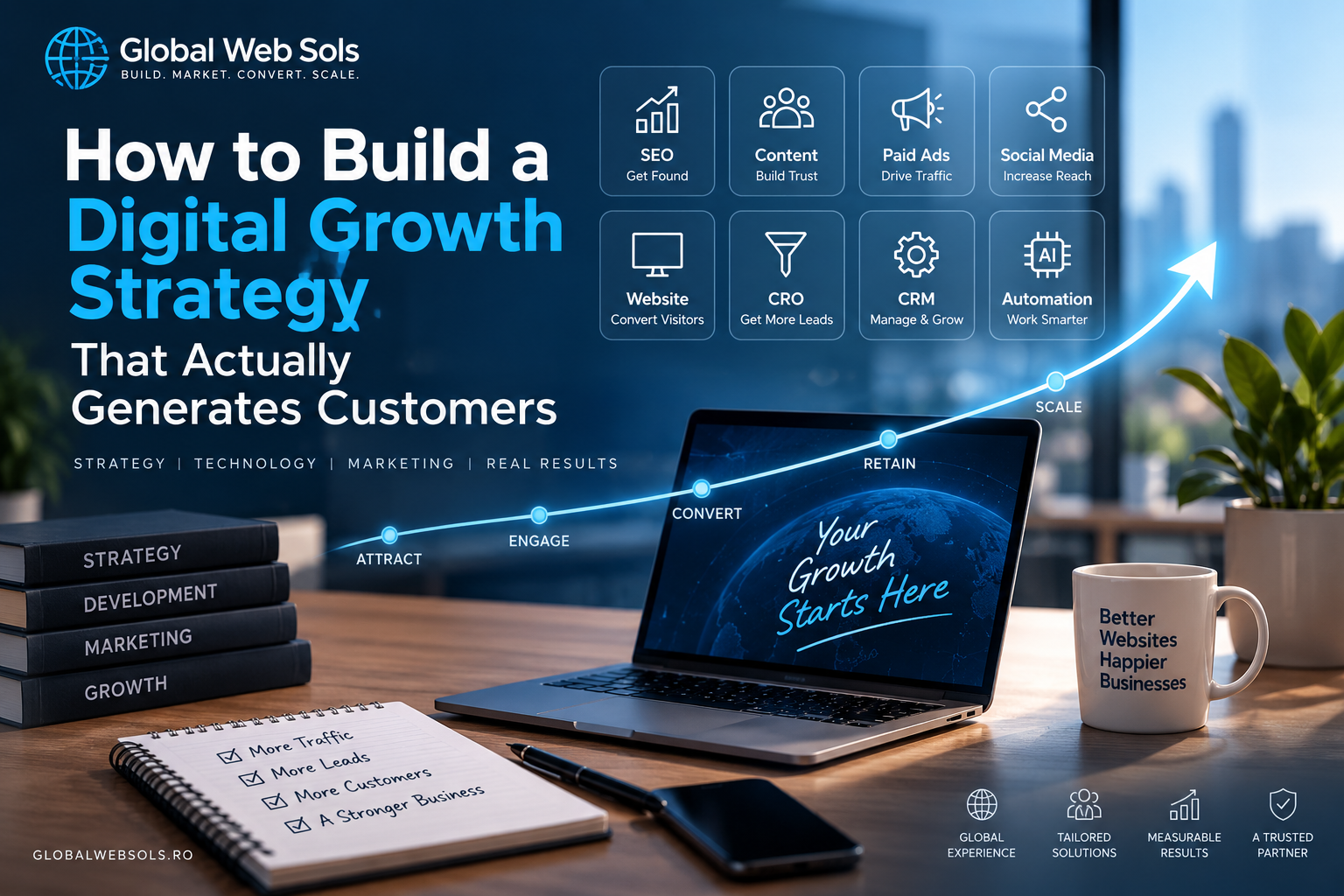
Build. Market. Convert. Scale.
This article explains how businesses can develop a practical digital growth strategy, which components matter most, common mistakes to avoid, and how technology and marketing can work together to create sustainable growth.
1. What Is a Digital Growth Strategy?
A digital growth strategy is a structured plan for using digital technology and marketing channels to attract potential customers, convert them into customers, retain them, and improve business performance over time.
It can include:
- Website development
- Search engine optimization
- Content marketing
- Paid advertising
- Social media marketing
- Conversion rate optimization
- eCommerce optimization
- Customer relationship management
- Marketing automation
- Analytics and tracking
- Artificial intelligence and automation
- Email marketing
- Landing pages
- Lead generation
The important part is not simply having all these components.
The important part is connecting them.
For example, a company might attract visitors through Google search. Those visitors land on a service page. The page explains the company’s offering and provides a clear call to action. The visitor requests an audit or consultation. The lead enters a CRM system. The sales team follows up. The business then analyzes the conversion data and improves the website.
That is a digital growth system.
2. Start With a Clear Business Objective
Before choosing marketing channels, define what you actually want to achieve.
A common mistake is starting with questions such as:
- Should we run Google Ads?
- Should we post more on Instagram?
- Should we invest in SEO?
- Should we redesign our website?
These questions are important, but they should come after defining the business objective.
For example, your objective could be:
- Generate more qualified leads
- Increase online sales
- Reduce customer acquisition costs
- Increase conversion rates
- Enter a new market
- Improve organic search visibility
- Build a predictable sales pipeline
- Increase repeat purchases
Once the objective is clear, you can determine which digital channels and technologies are appropriate.
Example
Suppose an eCommerce business wants to increase sales.
Its strategy might involve:
SEO → Organic traffic → Product pages → CRO → Checkout → Purchase → Retention
A B2B company may have a different system:
SEO/Ads → Landing page → Lead form → CRM → Sales follow-up → Customer
The technology changes according to the business model, but the principle remains the same: every activity should support a measurable business objective.
3. Build a Website That Supports Growth
Your website is often the central component of your digital ecosystem.
It is where advertising traffic lands, where search engines discover your content, where customers learn about your products or services, and where many conversions happen.
A website designed only to look attractive may not perform well commercially.
A growth-focused website should consider:
User experience
Visitors should be able to understand:
- What the company does
- Who it serves
- What problem it solves
- What makes the company different
- What action they should take next
Performance
Slow websites can create a poor user experience and can affect the effectiveness of other marketing channels.
Important technical considerations include:
- Page loading performance
- Mobile responsiveness
- Image optimization
- Efficient JavaScript
- Efficient CSS
- Browser caching
- Server performance
- Core Web Vitals
Conversion
Every important page should have a logical next step.
Depending on the business, this could be:
- Request a quote
- Book a consultation
- Start a free trial
- Buy a product
- Download a resource
- Contact the company
- Request an audit
The objective isn’t to put a button everywhere.
The objective is to make the next step clear when the visitor is ready.
4. SEO: Build Long-Term Organic Visibility
Search engine optimization remains an important part of digital growth because it allows businesses to attract people who are actively searching for information, products, or services.
However, SEO should not be treated as simply adding keywords to pages.
Modern SEO involves several areas.
Technical SEO
Technical SEO ensures that search engines can effectively discover, crawl, and understand your website.
This can include:
- Site architecture
- Crawlability
- Indexing
- XML sitemap
- Robots.txt
- Canonical URLs
- Mobile usability
- Structured data
- HTTPS
- Page performance
- Internal linking
On-page SEO
On-page optimization focuses on the content and structure of individual pages.
Important elements include:
- Page title
- Meta description
- H1 heading
- H2 and H3 headings
- Content structure
- Internal links
- Image alt text
- Search intent
- Relevant terminology
Content SEO
Useful content can help businesses establish topical relevance.
Instead of creating articles simply because a keyword has search volume, create content that genuinely answers questions potential customers have.
For example, a web development company could publish:
- How much does website development cost?
- How to choose a web development agency
- Website performance checklist
- Website redesign guide
- How to improve website conversions
These articles can then connect to relevant commercial service pages.
5. Search Intent Matters More Than Keyword Volume Alone
Not every search represents the same level of buying intent.
Consider these searches:
“what is SEO”
This is primarily informational.
“SEO checklist for ecommerce”
This is still informational but more specific.
“SEO services for ecommerce”
This has commercial intent.
“SEO agency for ecommerce”
This is much closer to a potential purchasing decision.
A strong SEO strategy recognizes these differences.
Your website should contain different types of content for different stages of the customer journey.
Informational content
Helps people understand a topic.
Commercial content
Helps people compare solutions.
Transactional/service pages
Help people take action.
A digital growth strategy should connect all three.
6. Content Marketing Should Support Your Services
Publishing content consistently can help build authority, attract search traffic, educate potential customers, and create opportunities for internal linking.
However, businesses sometimes publish hundreds of articles that have little relationship to their actual services.
A better approach is to build topic clusters.
For example, a company providing CRO services could have:
Main service page:
Conversion Rate Optimization Services
Supporting content:
- What Is Conversion Rate Optimization?
- How to Improve Website Conversion Rates
- Common Landing Page Mistakes
- A/B Testing Explained
- eCommerce Conversion Optimization
- Checkout Optimization Guide
Each supporting article can link naturally to the main CRO service page.
This creates a connected content structure.
7. Paid Advertising Can Accelerate Customer Acquisition
SEO can take time to build. Paid advertising can provide businesses with an additional acquisition channel.
Common platforms include:
- Google Ads
- Meta Ads
- Instagram advertising
- TikTok Ads
- LinkedIn advertising
The goal shouldn’t simply be to generate clicks.
A campaign needs to be connected to what happens after the click.
For example:
Advertisement → Landing page → Offer → Form → CRM → Follow-up
If the advertisement generates 1,000 visitors but the landing page doesn’t communicate the offer clearly, the campaign may produce disappointing results.
This is why paid advertising and conversion optimization should work together.
8. Landing Pages Are Critical for Campaign Performance
A landing page should usually have one primary objective.
For example:
Request a free SEO audit.
The page should make that objective obvious.
A good landing page generally includes:
- Clear headline
- Relevant value proposition
- Explanation of the offer
- Benefits
- Supporting evidence
- Trust elements
- Clear call to action
- Simple form
- Mobile-friendly design
One common mistake is sending every advertising campaign to the homepage.
A dedicated landing page can provide a more focused experience because its content can match the advertisement and the user’s intent.
9. Conversion Rate Optimization Turns Traffic Into Opportunities
Getting traffic is only part of the equation.
Suppose two websites each receive 10,000 monthly visitors.
Website A generates 100 leads.
Website B generates 300 leads.
The difference isn’t necessarily traffic. It may be the quality of the experience and conversion system.
Conversion Rate Optimization (CRO) focuses on identifying and improving the factors that influence whether visitors take the desired action.
CRO can involve:
- Headlines
- Calls to action
- Forms
- Page layouts
- Trust signals
- Pricing presentation
- Navigation
- Product descriptions
- Checkout experiences
- Mobile usability
Testing should be based on evidence rather than assumptions.
Analytics, user behavior, and controlled experiments can help businesses determine what needs improvement.
10. Build a Lead Generation System
A website form should not simply send an email and disappear.
A more effective system can capture the lead and organize it.
For example:
Visitor
↓
Enquiry form
↓
Lead database
↓
CRM
↓
Lead status
↓
Sales follow-up
↓
Qualified opportunity
↓
Customer
A CRM makes it easier to know which prospects are:
- New
- Contacted
- Qualified
- Won
- Lost
This creates visibility into the sales pipeline.
11. CRM Systems Connect Marketing With Sales
Marketing and sales should not operate as completely separate departments.
Marketing generates opportunities.
Sales follows up with those opportunities.
A CRM connects the two.
A useful CRM can store information such as:
- Customer name
- Company
- Phone
- Website
- Requested service
- Budget
- Lead source
- Status
- Priority
- Notes
- Follow-up information
This allows a business to understand not just how many leads it generates, but what happens to those leads afterward.
12. Marketing Automation Reduces Repetitive Work
Automation can reduce repetitive administrative tasks.
For example:
A visitor submits a form.
The system can:
- Save the lead.
- Send a notification.
- Assign a lead status.
- Record the source.
- Trigger an internal follow-up process.
- Add relevant information to the CRM.
Automation can also be used for:
- Email sequences
- Lead follow-ups
- Customer onboarding
- Appointment reminders
- Reporting
- Data synchronization
- Internal notifications
The objective isn’t to automate everything.
The objective is to automate repeatable processes where automation provides a clear benefit.
13. Analytics Makes the Strategy Measurable
Without measurement, digital marketing becomes difficult to improve.
Businesses should understand where visitors come from and what they do afterward.
Useful metrics can include:
Traffic
How many visitors are reaching the website?
Engagement
What pages are they viewing?
How long are they staying?
Conversion rate
What percentage of visitors complete the desired action?
Lead volume
How many enquiries are being generated?
Lead quality
How many leads are actually relevant?
Customer acquisition cost
How much does it cost to acquire a customer?
Revenue
What business value is being generated?
The exact metrics depend on the business model.
14. Connect Google Analytics With Search Data
Analytics can show what users do on your website.
Search Console can show how people discover your website through Google Search.
Together, they provide a more complete picture.
You can identify:
- Search queries
- Impressions
- Clicks
- Click-through rate
- Average search position
- Landing pages
- Organic traffic
- Conversion behavior
For SEO, this information is particularly useful because it can reveal pages that already receive impressions but need further optimization.
15. Social Media Should Support the Brand
Social media is useful for building awareness, communicating with audiences, distributing content, and supporting customer relationships.
However, businesses shouldn’t feel that they need to be everywhere.
The appropriate platforms depend on the audience.
For example:
- LinkedIn can be useful for B2B companies.
- Instagram can support visual brands.
- TikTok can support short-form video strategies.
- Facebook can support communities and advertising.
- YouTube can support educational and long-form video content.
The important thing is consistency and relevance.
Social media should ultimately connect back to the broader business strategy.
16. eCommerce Growth Requires More Than Advertising
For online stores, digital growth extends beyond attracting visitors.
The complete journey might look like:
Search → Product page → Add to cart → Checkout → Purchase → Retention
Every stage matters.
eCommerce businesses should consider:
- Product page quality
- Product photography
- Descriptions
- Reviews
- Pricing
- Shipping information
- Trust signals
- Mobile experience
- Checkout usability
- Payment options
- Abandoned cart recovery
- Customer retention
Improving one stage can influence the performance of the entire funnel.
17. Artificial Intelligence and Automation
AI is becoming an increasingly important component of digital business systems.
Businesses can explore AI for:
- Customer support
- Content assistance
- Data analysis
- Lead qualification
- Workflow automation
- Internal knowledge systems
- Customer communication
- Reporting
- Process optimization
However, AI should solve a real business problem.
Adding AI simply because it is popular doesn’t automatically create value.
A better approach is:
Identify repetitive problem → Define desired outcome → Select appropriate technology → Measure result
This keeps automation focused on business needs.
18. Build a Strong Internal Linking Structure
Internal linking is often overlooked.
Suppose you have:
- SEO service
- CRO service
- Shopify service
- SEO article
- CRO article
- Shopify article
- SEO audit tool
- eCommerce case study
These pages should not exist independently.
They can be connected naturally.
For example:
SEO article → SEO service → SEO audit
Shopify article → Shopify service → eCommerce case study
CRO article → CRO service → CRO case study
Internal links help users discover related information and help search engines understand the relationships between pages.
19. Case Studies Build Trust
Potential customers often want evidence that a company can actually deliver.
Case studies provide that evidence.
A useful case study can explain:
The challenge
What problem did the client face?
The strategy
What approach was used?
The implementation
What technology, design, marketing or optimization work was completed?
The outcome
What measurable or observable improvement resulted?
The lessons
What can other businesses learn from the project?
Case studies can also support SEO by creating relevant content around the services you provide.
20. Backlinks Should Be Built Carefully
External links from other websites can contribute to a website’s authority and discoverability.
But the objective should not be:
“Get as many backlinks as possible.”
Instead:
Build relevant, credible references to your business.
Potential sources can include:
- Relevant business directories
- Industry directories
- Professional associations
- Partner websites
- Client websites
- Business publications
- Technology websites
- Guest contributions
- Interviews
- Original research
- Useful resources
Avoid relying on automated systems that generate large numbers of irrelevant links.
Quality, relevance and editorial context matter.
21. Local and International SEO Can Coexist
A company can serve international customers while maintaining a strong local business presence.
For a company based in Romania, this could mean maintaining accurate business information while also building content around international services.
The key is not to create hundreds of low-quality location pages.
Instead, build useful pages where there is genuine relevance.
For example:
Service
→ SEO Services
Industry
→ eCommerce & Retail
Solution
→ Lead Generation
Market
→ International customers
This structure can support different search intents without creating unnecessary duplicate content.
22. Website Security and Technical Maintenance Matter
A growth strategy isn’t complete without technical maintenance.
Businesses should monitor:
- HTTPS
- Broken links
- Server errors
- Indexing issues
- Website availability
- Security
- Forms
- Analytics
- Tracking
- Page speed
- Mobile usability
A website that generates leads but has broken forms can lose opportunities.
Likewise, a website that cannot be crawled properly can limit organic visibility.
Technical maintenance is therefore part of marketing performance.
23. Create a Continuous Optimization Process
Digital growth shouldn’t be treated as a one-time project.
A better cycle is:
Build → Measure → Learn → Improve → Repeat
For example:
Month 1
Establish analytics, technical SEO and conversion tracking.
Month 2
Improve service pages and publish supporting content.
Month 3
Analyze search performance and conversion data.
Month 4
Improve pages based on actual user behavior.
Month 5
Expand successful campaigns.
Month 6
Test new acquisition channels.
The exact timeline depends on the business, but the principle remains the same.
24. Common Digital Growth Mistakes
Several problems appear repeatedly.
Focusing only on traffic
Traffic is useful, but traffic without conversions doesn’t necessarily create business growth.
Running advertising without tracking
Without reliable tracking, it becomes difficult to understand campaign performance.
Publishing content without strategy
More articles do not automatically mean more customers.
Ignoring conversion optimization
Increasing traffic while leaving conversion problems unresolved can limit growth.
Treating CRM as an afterthought
Leads need a structured follow-up process.
Automating everything
Automation should solve problems rather than create unnecessary complexity.
Ignoring mobile users
A significant portion of digital interactions happen on mobile devices.
Buying large quantities of backlinks
Low-quality or irrelevant links can create a poor backlink profile.
25. A Practical Digital Growth Framework
A practical framework for businesses can be divided into six stages.
Stage 1: Build
Create the technology foundation.
- Website
- eCommerce platform
- Landing pages
- Analytics
- Tracking
- CRM
Stage 2: Attract
Bring qualified people to the business.
- SEO
- Content marketing
- Google Ads
- Meta Ads
- Social media
- Partnerships
Stage 3: Engage
Help visitors understand the value of the offer.
- Useful content
- Strong messaging
- Case studies
- Educational resources
- Product information
Stage 4: Convert
Turn visitors into leads or customers.
- Calls to action
- Forms
- Landing pages
- CRO
- Checkout optimization
- Offers
Stage 5: Manage
Organize prospects and customers.
- CRM
- Lead tracking
- Automation
- Follow-ups
- Customer management
Stage 6: Scale
Use data to improve what is already working.
- Analytics
- Testing
- Campaign optimization
- SEO expansion
- Automation
- New channels
26. How Global Web Sols Approaches Digital Growth
At Global Web Sols, our approach combines technology, design and performance marketing.
We work across areas including:
- Web development
- WordPress development
- Shopify development
- eCommerce
- SEO
- Conversion rate optimization
- Google Ads
- Meta Ads
- TikTok Ads
- Social media marketing
- Content marketing
- CRM solutions
- Marketing automation
- AI automation
- Website optimization
Rather than treating each service as an isolated activity, the objective is to create connected digital systems.
For example, a business might need a new website.
But the project may also require:
Website → SEO → Analytics → CRO → Lead generation → CRM
An eCommerce company might require:
Shopify → SEO → Paid advertising → Product optimization → CRO → Analytics
A B2B company might need:
Website → Content → SEO → Lead generation → CRM → Sales automation
The appropriate strategy depends on the company’s objectives, audience, industry and existing digital infrastructure.
27. Final Thoughts
Digital growth is not about finding one marketing channel that solves every problem.
It is about building a connected system.
A successful strategy can combine:
Technology
with
Marketing
with
Conversion optimization
with
Data
with
Automation
The businesses that approach digital growth as a system can make better decisions because they can see how different activities influence the customer journey.
Your website attracts attention.
SEO helps people discover you.
Content builds understanding.
Advertising accelerates acquisition.
CRM organizes opportunities.
Automation reduces repetitive work.
Analytics provides the information needed to improve.
When these components work together, digital marketing becomes more than a collection of individual activities. It becomes a structured growth system.
Ready to Build Your Digital Growth System?
Whether you need a new website, better organic visibility, an eCommerce growth strategy, conversion optimization, paid advertising, CRM implementation or business automation, the first step is understanding where your current digital system is performing well and where opportunities exist.
Global Web Sols helps businesses build, market, convert and scale.
Explore our Web Development, SEO, eCommerce, CRO, Digital Marketing, CRM and AI Automation services, or use our Free SEO Audit to identify potential opportunities on your website.
Global Web Sols SRL
Romania · Serving clients worldwide
Build. Market. Convert. Scale.